Your Cart ( 0 )
15% Off Sitewide
Guaranteed Christmas Delivery
15% Off Sitewide
Guaranteed Christmas Delivery

“Four main pearl types dominate fine jewelry. Japanese Akoya, black Tahitians and White or Golden South Sea are all saltwater pearls. Freshwater pearls from China round out the set.” – Ashley McNamara, Pure Pearls
Choosing the right pearl isn’t just about style, when it comes to pearl identification, it’s about understanding the story behind each gem and how they'll connect to your own.
Modern pearls come in five main types of pearls: Akoya, Tahitian, Freshwater, White and Golden South Sea, and Sea of Cortez.
Each of these pearls carries its own distinct character, color, and charm, and are shaped by the waters where they grow. Once you master understanding about the different types of pearls to choose from, you will gain the confidence to select not only a beautiful piece of jewelry, but one that reflects your personality, your values, and the milestones that matter most.
This knowledge is the real secret to finding pearls that will become part of your family’s story: heirlooms that celebrate love, grace, and generations of memories. Whether it’s the lustrous perfection of an Akoya strand, the bold mystery of Tahitian pearls, or the sunlit warmth of Golden South Sea pearls, understanding these differences ensures that your choice delivers both lasting value and deep meaning.
My Guide to Cultured Pearl Types was written to help you discover which pearl type really speaks to your heart, so you can choose a treasure worthy of your family’s legacy.
Here's a quick breakdown of each major pearl type before I give a more detailed overview about what to expect. Here we'll list the various pearl types and quality ranges, so you can quickly identify which pearl type is best for you.
This short, visuals-rich overview will provide you with the “Quick-Start” info you need to make an informed decision about which of the different types of pearls you’d like to buy.
Bonus link: How To Buy Pearls
| Pearl Type | Water | Size Range | Common Colors | Luster Range | Price | Ideal For |
| Akoya Pearls | Saltwater | 6.0-9.5mm | White, with overtones of Rose, Silver and Cream, Dyed Black | High to Excellent | $$ - $$$+ | Classic Pearl Necklaces, Bracelets and Earrings |
| Tahitian Pearls | Saltwater | 8.0-14.0mm and up | Black with Overtones of Peacock, Silver, Green and Rose | Satiny to Excellent | $$$ - $$$$+ | Statement Pieces, Men’s Jewelry, Luxury Sets
|
| White and Golden South Sea Pearls | Saltwater | 9.0-16.0mm and up | Natural White with Silver, Rose and Cream overtones, Natural Gold Hues | Very High, Satiny Glow | $$$$+ | Heirloom Strands, Investment Jewelry
|
| Freshwater Pearls | Freshwater | 6.0-12.0mm and up | White, with overtones of Rose, Silver and Cream, Dyed Black and Every Other Color | Very High, Satiny Glow | $ - $$ | Everyday Jewelry, Budget-Friendly Gifts
|
There are many different types of pearls, each with its own beauty and story. Most pearls you see today are cultured pearls, which means they are carefully grown with the help of pearl farmers who place a tiny bead or tissue inside an oyster or mussel to begin the pearl’s growth. The cultured types of saltwater pearls are the ones grown with an internal bead nucleus, while most types of Freshwater pearls are tissue-nucleated (with some exceptions). Natural pearls form on their own in the wild without any human help, making them extremely rare and valuable. Both types share the same magical shimmer: pearls are a symbol of purity, elegance, and timeless style.
Among the types of cultured pearls, four stand out for their unique charm.
Together, these different types of pearls show the endless beauty nature can create ... each one is a small, yet precious treasure from the sea.
Now let's get into a detailed breakdown of each pearl type: it's origin, size ranges, colors, estimated values and when or why you as a customer would choose a particular pearl type to buy.
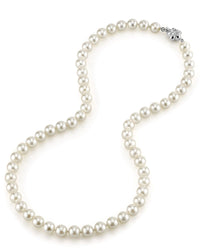
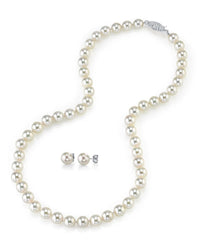
Perfectly round in shape, white and shining with bright, mirror-like luster, cultured saltwater Akoya pearls are The Classic White Pearl that every woman wants to have in her jewelry box.
Cultured Akoya pearls are grown in the Pinctada fucata martensii saltwater oyster, native to the colder waters of the Pacific Ocean surrounding Japan, and abutting southern China and Vietnam, as shown in the map above.
The Official Akoya Pearls Buyer's Guide
The Ultimate Akoya Pearl Grading Guide
The Insider's Guide to Hanadama Akoya
Cultured Freshwater pearls from China present a rainbow of beautiful natural colors, and an incredible variety of sizes and unique pearl shapes that range from free form baroques to perfect rounds.
Less expensive than saltwater cultured pearl types like Akoya, Tahitian and South Sea pearls, Freshwater pearls are farmed in natural and man-made freshwater lakes and ponds in China.
Grown in the Hyriopsis cumingii “Triangle shell” Freshwater pearl mussel, the yearly Freshwater pearl harvests dwarf that of saltwater cultured pearls many times over by volume.
There are other types of Freshwater pearls such as Edison Freshwater pearls, Soufflé Freshwater pearls, and Freshwater pearls from Lake Kasumiguara in Japan, however these are primarily collector's items and not typically items you'll find at regular pearl specialists.
The Official Freshwater Pearls Buyer's Guide
The Ultimate Freshwater Pearl Grading Guide
Cultured Tahitian pearls are the most famous and prevalent naturally Black cultured saltwater pearls in the world. There is perhaps no piece of jewelry quite as exotic as a fine strand of Tahitian Pearls.
Main, primary body colors range from pale Dove Grey to very Dark Charcoal Grey (and rarely, a near true, jet black color), and the pearls shimmer with gorgeous, iridescent overtones (secondary colors) of Peacock, Green, Blue-Green, Silver/Steel, Cherry and more.
Tahitian pearls are farmed in the tropical atolls and saltwater lagoons of the islands in French Polynesia. Grown in the Pinctada margaritifera saltwater pearl oyster, which can attain sizes of up to a foot in diameter, Tahitian pearls are one of the largest cultured pearl types in the world.
The Official Tahitian Pearls Buyer's Guide
The Ultimate Tahitian Pearl Grading Guide
White and Golden South Sea pearls are the largest and most luxurious of all cultured pearl types on the market today.
Often called the “Queen of Pearls”, South Sea pearls feature a gorgeous palette of natural Golden and White colors that shimmer with delicate overtones and are simply unmistakable. A fine strand of South Sea pearls is the ultimate in luxury!
South Sea pearls are farmed in the Pinctada maxima saltwater oyster, which grows up to a foot in diameter at maturity. It is the largest pearl producing oyster in production today.
In order to maintain the genetic diversity of the oyster population, ONLY wild oysters are bred to create farm stock, and then released back to the oceans.
The Official South Sea PearlBuyer's Guide
The Ultimate South Sea Pearl Grading Guide
Cultured pearls from the Sea of Cortez (aka the Gulf of California) in Guyamas, Mexico are THE RAREST cultured pearls in the entire world.
These pearls are also the only other naturally-colored “black” cultured pearl type besides Tahitians available on the jewelry market today.
Farmed on only a single pearl farm operating out of Guyamas, Mexico, Sea of Cortez pearls are incredibly colorful pearls … more intense in hue and overtone than Tahitian pearls, and with a distinct palette of “traditional” Sea of Cortez colors that sets them apart from any other cultured pearl type in the world.
Learn More About Sea of Cortez Pearls
An Interview with Douglas McLaurin, Creator of Sea of Cortez Pearls
Knowing how to identify different kinds of pearls allows you to recognize their value and beauty at a glance. Each pearl type has distinct traits shaped by its origin, water temperature, and mollusk species. By learning these differences (color, size, shape, and luster), you can easily tell an Akoya from a Tahitian or South Sea, and ensure that the pearl you choose truly suits your taste and purpose.
The chart below will help you quickly identify each of the major pearl types by color, size range, what their luster will look like and other distinctive traits and origins.
| Pearl Type | Typical Colors | Average Size Range | Luster Quality | Distinctive Traits / Origin |
| Akoya Pearls | White, Black (Dyed) | 5.0-10.0mm | Mirror-Like | Perfectly Round, Classic Japanese Pearls; Known For Timeless Beauty |
| Freshwater Pearls | White, Pink, Peach, Lavender, and Black (Dyed) | 5.0-12.0mm and up | Satiny to Very High | Grown In Lakes/Rivers; Variety Of Shapes And Pastel Tones |
| Tahitian Pearls | Natural Black / Charcoal Grey with Iridescent Overtones | 8.0-15.0mm and up | Satiny to Excellent | Naturally Black Saltwater Pearls Grown In French Polynesia. Bold, Exotic Looks |
| White South Sea Pearls | Natural White with Rose, Silver and Cream Overtones | 9.0-16.0mm and up | Satiny to Excellent | Farmed in Australia, Known for Large Sizes and Silvery-White Colors |
| Golden South Sea Pearls | Natural Gold with Rose, Gold and Bronze Overtones | 9.0-16.0mm and up | Satiny to Excellent | Farmed in the Philippine Islands, Known for Large Sizes and Deep Golden Colors[ |
| Sea of Cortez Pearls | Multi-Color, Natural Black/Grey with Wide Variety of Overtones | 8.0-12.0mm and up | Satiny to Excellent | Extremely Rare; Cultivated in Mexico; Prized For Unique Coloration
|
Choosing the best pearl type for your budget starts with knowing that every pearl - from the most affordable to the most luxurious - carries its own distinct beauty and charm. Whether you’re seeking your first classic pearl necklace or investing in a lifelong heirloom to be passed down through the generations, there’s a pearl to match every vision and price range.
Each one of the unique kinds of pearls offers something special to admire (and I freely admit I have a fondness for the underdog - Freshwater pearls - for their luminous, subtle glow and lower price points because I truly want pearls to be accessible to everyone!). From luminous simplicity to breathtaking opulence, no matter your budget, the natural, organic beauty of the pearl is something that every jewelry lover can enjoy. What truly matters is finding the pearls that resonate with your heart and your story.
At Pure Pearls, every piece - regardless of price - is handcrafted by skilled jewelers who uphold the highest standards of quality; we want every piece of pearl jewelry to become a lasting symbol of love, joy, and cherished memories.
Typical Budget Ranges by Pearl Type:
Freshwater Pearls: Ideal for new collectors. $100–$800 for necklaces or earrings with soft pastel tones and varied shapes.
Akoya Pearls: The classic choice! $500–$8,500 for perfectly round, mirror-luster pearls that embody timeless elegance.
Tahitian Pearls: Exotic, bold and mysterious. $800–$20,000 depending on size, color, and luster, offering striking dark iridescence.
White South Sea Pearls: Luxurious, luminous and utterly glamorous $2,000–$50,000+ for silky, satiny pearls prized for their size and prestige.
Golden South Sea Pearls: The pinnacle of sunlit warmth and rarity. $3,000–$50,000+, glowing with natural golden hues that radiate sophistication.
No matter your budget, Pure Pearls ensures that every creation reflects exceptional craftsmanship and enduring beauty: these are treasures meant to be worn, celebrated, and passed down through generations.
There are four main types of cultured pearls: Akoya, Freshwater, Tahitian, and South Sea.
Akoya Pearls: Classic, perfectly round pearls from Japan, known for their bright, mirror-like luster and timeless elegance.
Freshwater Pearls: Grown in freshwater rivers and lakes in China, offering soft pastel colors, varied shapes, and exceptional value.
Tahitian Pearls: Naturally dark pearls from French Polynesia, admired for their bold size and exotic peacock, blue-green and silver hues.
South Sea Pearls: The largest and rarest pearls, cultivated in Australia and the Philippines, glowing with a soft white or golden color.
Four major kinds of pearls that dominate fine jewelry, with several rare natural varieties.
Akoya, Freshwater, Tahitian, South Sea are the primary cultured pearl types.
Pink Conch pearls, Keshi pearls, iridescent Clam pearls and orangey-yellow Melo pearls are wild, natural pearls or specialty collector's items.
Akoya pearls are known for the sharpest, mirror-like luster.
High nacre density, and tight crystalline nacre layers combine to create brilliant light return, no matter the pearl type.
Freshwater pearls are the most durable and affordable for daily use, from office to casual to Holidays.
Freshwater pearls offer solid crystalline nacre and minimal care needs.
They are available in many sizes and colors, all of which are versatile and occasion acceptable.
White and Golden South Sea pearls are the rarest and command the highest value.
Luxuriously large sizes ranging from 8.0-16.0mm all the way up to 21.0mm at their very largest, and touchable, glowing luster make these gems investment-grade pearls that will last generations.
Both White and Golden South Sea pearls are often used in luxury jewelry, couture designs and heirloom pieces.
Freshwater pearls are grown in rivers and lakes; saltwater pearls are cultured in oceans.
Freshwater are much more abundant and lower-cost than other saltwater pearl types.
Saltwater pearls (Akoya, Tahitian, South Sea) have higher luster and rarity per harvest.
Neither pearl type is “better” in that both serve different preferences. When it comes to Akoya vs South Sea pearls, you'll need to decide between luxurious sizes over razor-sharp luster, and discover which pearl type is more valuable to you.
Akoya are smaller, with sharper luster
South Sea are larger, with softer, satiny glow
Freshwater pearls offer the best quality-to-price ratio; these are one of the best types of pearls and value.
Freshwater pearls are both widely available and very durable, and will look beautiful for generations to come.
Beautiful natural colors like pink, peach, lavender and white at lower costs than any other pearl type.
You can identify your pearl type using color, size, quality of luster and overtone.
Akoya: perfectly round in shape, typically white with a faint rose overtone, high, mirror-like luster and versatile sizes ranging from 5.0-9.5mm. Dyed black Akoya pearls are available and display a stark, uniform, Midnight Blue-Black color.
Freshwater:varied shapes like off-round to ovals and egg-shapes, softer, more satiny luster, colors are pink, peach, lavender and usually a creamy white. Dyed black Freshwater pearls are available and display an iridescent, usually denim blue hue, although purples and coppers are also commonly seen. Sizes range from 6.0-12.0mm typically.
Both White South Sea and top-grade Hanadama Akoya pearls make enduring heirlooms, suitable for families to pass down throughout the generations.
Both pearl types feature exceptional nacre thickness for longevity.
White South Sea and Hanadama Akoya pearls both hold long-term aesthetic, branding and market value.
About the Author
Ashley McNamara, of PurePearls.com, is a GIA-certified expert in Pearls, Diamonds, and Colored Stones and widely recognized as “the expert’s expert” in the pearl industry. With over 20 years of experience, she contributed to the CPAA’s Pearls As One educational course and has been cited by major news outlets nationwide. Ashley's keen eye for color and luster make her a trusted source for classic and exotic pearls alike. Explore her bestselling collections here.

Stay up to date on our latest products, news, discounts, and more!
Free 2-Day FedEx on all orders within the USA. Overnight delivery options start at $35.
Most orders ship within 1-2 business days, sometimes same day.
International shipping is affordable and fast. Most international packages arrive in 2-4 business days.
Your package is fully insured. If your order is lost or stolen before delivery, we got you covered.
Our Pricing Explained
Luxury Grade Pearls. Lower Prices.
Luxury Grade Pearls.
Lower Prices.
The true value of pearls lies in their quality. We sell true luxury grade pearls without traditional luxury store markups.
We source the worlds finest pearls and sell direct to customers like you. You can expect to save about 1/2 the cost of traditional retail.


Pure Pearls Pricing

Traditional Retail Pricing