Your Cart ( 0 )
Free 2-Day FedEx & 90-Day Returns
*Free 2-day FedEx on US orders
Free 2-Day FedEx & 90-Day Returns
*Free 2-day FedEx on US orders

I get so many questions about our Hanadama pearls. What are Hanadama pearls? What makes Hanadama pearls special? Are Hanadama pearls worth the price? So I put together this expert's guide to Hanadama pearls for you. In it you will learn what makes these pearls so special, what to look for, how to compare Hanadama pearls to AAA Akoya pearls, Mikimoto pearls and more.
Hanadama Akoya pearls represent the top tier of Akoya pearls and are independently certified for exceptional luster, surface quality, and nacre thickness.Meanwhile, AAA Akoya pearls are a high-quality commercial grade without third-party certification. The right choice depends on whether you value maximum brilliance and certification or excellent quality at a lower price point.
— Ashley McNamara, Pure Pearls
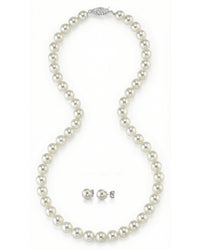
👉 Shop Pearls: The Hanadama Collection
Use the links below to navigate quickly to specific questions you have, or read the whole guide.
Hanadama is a designation given only to Japanese Akoya pearls that pass strict laboratory testing for luster, surface quality, nacre thickness, and color balance.
The term “Hanadama” was coined by the father of cultured pearls himself, Kokichi Mikimoto. He used this term to designate his finest, most beautiful Akoya pearls.
“Hanadama” directly translates from Japanese to “Spherical Flower” and are also often called “Flower Pearls” by those in the trade. The delicate shades of pink shimmering over their surfaces are said to be reminiscent of the famous Cherry blossoms that bloom throughout Japan in the Springtime.
👉Learn More: The Ultimate Guide to Buying Akoya Pearls
The Quick Answer Is: Luster, Luster, Luster, and Orient!
These two attributes, above all others, make a pearl valuable. The brighter and more iridescent a pearl is, the prettier it is. The luster and orient on Japanese Hanadama Akoya pearls is certified to be the very highest and strongest of all Akoya pearls.
These attributes are analyzed and certified to meet specific levels set by the Pearl Science Laboratory of Tokyo, Japan. The PSL is the foremost authority on Hanadama pearls, and the only official Hanadama grading lab in the world.
Luster is the pearl attribute that quantifies the amount of, brightness of and sharpness of light being reflected from the surface or just under the surface of the pearl. Hanadama Akoya pearls should feature extremely sharp luster. Light sources reflected on the surface of the pearl will be very sharp and crisp, with almost no diffused or blurred edges of light reflections. You’ll be able to see your detailed reflection smiling back at you when you examine the pearls.
Orient is the iridescent “soap bubble” effect seen only on the finest pearls. White light striking and penetrating the various nacre layers is broken into its spectral rainbow (much like the ‘fire’ in a diamond) and bounced back at the viewer.
These “attributes” are two of the three defining characteristics of Hanadama pearls. The third is nacre thickness. Neither fine luster nor orient would be possible without thickly layered, and tightly compacted crystalline nacre. This is a key element to consider when grading pearls of fine quality.
Nacre is the term used to sum up all the aspects of the crystalline platelets that make up the body of the pearl surrounding the nucleus. It is composed of microns-thin transparent aragonite platelets (themselves made on crystallized calcium carbonate or CaCo3), and densely layered with conchiolin – an organic glue of sorts - in concentric layers around the mother of pearl bead nucleus. See the diagram below for a visual example.
👉Learn More: Understanding Pearl Nacre And Luster
Below is a copy of a Hanadama Akoya Pearl Necklace certificate, as issued by the Pearl Science Laboratory of Tokyo, Japan. The most pertinent information is highlighted and explained in detail.
To learn more about common Akoya pearl inclusions, visit: The Insider's Guide To Akoya Pearl Grading
Notice that the Pearl Science Laboratory issues Hanadama Certificates that all feature a range of “very slight imperfections” or “very strong luster”. There is a lot that can fall within that range – and pearl markets have been flooded with just-barely-made-it certified strands and even fake certifications, drowning out the best Akoya pearls.
What’s a pearl buyer to do?
Understand That Price Isn’t Everything: the old adage that you get what you pay for holds true today, even in the world of online bargains. If you spot a Hanadama strand with suspiciously-low price points, it may just be a lower-quality strand falling on the low end of the certification, or it may not actually be a certified strand at all.
The picture below shows one of our 8.0-8.5mm Hanadama Akoya necklaces compared to a competitor’s we purchased for a few hundred less than ours is listed for – the difference in luster, surface quality and iridescence is instantly noticeable.
A closer look at these two strands reveals marked differences in quality.
The disparity in the luster and iridescence (orient) are the two biggest factors that immediately grab the eye.
But also notice the tighter, more compact crystalline arrangement which leads to a deeper surface glow, the appearance of translucency and an overall glossier finish to the pearls’ surfaces.
In terms of value and pure quality, our strand is heads above the one from the online discount pearl source.
Ensure Your Certificate is Genuine –The PSL issues laminated certificates with individual, unique serial numbers, a metallic rainbow “Pearl Quality” Aurora logo and a PSL watermark stamped in the center of the certificate. All of these elements MUST be present on the certificate. Make sure that the exact strand or pair of pearls pictured on the certificate are the pearls you now possess, and check to make sure that pearl sizes and pearl necklace count match what is pictured.
The easiest way to spot an altered “certified strand” of Hanadama pearls is by counting the pearls in the strand and comparing it to the photo on the certificate. An 18-inch strand will vary by 2-3 pearls on average, so customized strands will have differing numbers of pearls. This may be complicated if you combine two 18-inch hanks to make a 36-inch Opera length necklace and so on, but in those cases, you should receive more than one certificate and be advised of what happens when you combine Hanadama strands.
Certified Hanadama pearls come in a series of standardized necklace and bracelet lengths as well as matched pairs to create earrings. These are:
Pro-Tip: A pearl necklace’s total length includes silk knotting in between each pearl, and the clasp. The proper way to measure a necklace’s true length is to stretch the necklace out end to end and begin measuring at the starting pearl through to the end of the clasp. Due to natural variations in pearl sizes throughout a necklace’s layout, an 18-inch measurement is approximate, and may be slightly shorter or longer than exactly 18 inches. Click here to learn how to properly measure a pearl necklace.
Akoya pearl sizes are measured in half-millimeter increments like 6.0-6.5mm, 7.0-7.5mm and so on. The largest size most Akoya pearls can attain is 9.5-10.0mm and they are very rare. Most Hanadama certified strands are available in sizes 7.0-7.5mm up through 9.0-9.5mm, which are the most popular and versatile sizes for women. Hanadama necklaces measuring 9.5-10.0mm in size are available upon special request, and are very expensive due to their rarity.
👉Learn More: The Ultimate Guide To Pearl Sizes
As mentioned earlier in this article, breaking a matched pair of Hanadama certified pearls invalidates certificates. Conversely, specially requesting certified singles would add so much to the overhead that a single Hanadama pearl pendant would be unattainable for many, so that’s the reason why you won’t find single Hanadama pearls for pendants and rings on pearl jewelry sites online.
Our best recommendation would be to purchase a matched pair and have the pearls set on your choice of mountings, or request AAA Quality pearls that get as close as possible to the Hanadama grade in terms of luster, iridescence and overall beauty.
There are pros and cons to both Hanadama and AAA selections, but the primary difference between the AAA grade Akoya necklace and the Hanadama strand is going to be one of luster and orient.
Remember:Hanadama pearls are certified in an exact necklace length (usually 18 inches). If a vendor is a major player longer necklace can be made by combining or breaking apart certified strands to create custom lengths.
AAA Quality Akoya strands can be made into any length or configuration (double or triple strands and so on). In terms of flexibility in creating a unique piece of pearl jewelry, then the AAA Quality Akoya pearls are the way to go
Hanadama pearls command a higher price because they represent a smaller, more tightly selected portion of each harvest and include independent certification. That premium reflects consistency, rarity, and added transparency. AAA Akoya pearls, on the other hand, offer excellent visual appeal and classic elegance at a more accessible price point, making them a popular choice for buyers who prioritize beauty and value without formal certification.
Both Hanadama and AAA Akoya pearls can be strikingly beautiful, especially when well matched and thoughtfully selected. The difference is how that beauty is verified. AAA pearls are graded visually by the seller, while Hanadama pearls are evaluated through independent laboratory testing. That certification doesn’t make a pearl beautiful on its own, but it does provide added confidence that luster performance, nacre thickness, and overall quality meet documented top-tier standards.
If you’re purely in the market for a Mikimoto AAA grade single-strand type of pearl necklace, then there is no better choice than a Hanadama certified strand.
As the photos above illustrate, both our AAA Quality Akoya and our Hanadama Collection Akoya pearls are beautiful. But, the Hanadama Akoya pearl is clearly superior in terms of luster and iridescence, and often boasts a depth and glow to their surfaces that is only possible due to their thicker nacre layers and fine crystalline structure.
Hanadama pearls are evaluated through independent laboratory testing. While AAA Akoya pearls are graded by various vendors on their own using their own grading scales, they aren't easily compared across vendors.
When a pearl is labeled AAA, it means the vendor has assessed its luster, surface quality, shape, and overall matching using their own internal standards. Most reputable pearl specialists apply careful, consistent grading, but because there’s no outside verification, slight differences can exist from one source to another.
Hanadama Akoya pearls go a step further. In addition to meeting very high visual standards, they’re reviewed by an independent Japanese testing lab with particular attention to luster performance, orient and nacre thickness. That extra level of evaluation helps remove guesswork and creates greater consistency from strand to strand. Both grades can be beautiful, but Hanadama offers added transparency for buyers who value documented quality.
Important to note that within the Hanadama pearl classification there is a range of quality still. Some strands will "just barely pass" while others will be "OMG how is this possible". Price is a good indication of where the strand will fall in this range.
👉Learn More: The Insider's Guide to Akoya Pearl Grading
| Feature | Hanadama Akoya Pearls | AAA Quality Akoya Pearls |
| Certification | Independently Certified (PSL, Japan) | No Third-Party Certification |
| Luster | Exceptional, Mirror-Like | Very High To Excellent |
| Surface Quality | Very Clean, Minimal Blemishes | MinorBlemishes Acceptable |
| Nacre Thickness | Verified 0.4mm Minimum Thick Nacre | Not Independently Tested |
| Origin | Japan | Japan |
| Price Range | $$$ - $$$$ | $$ - $$$ |
| Best For | Collectors, Heirloom Jewelry | Everyday Luxury, Value Buyers
|
Now that you have an understanding of Hanadama pearls and what makes them special, let’s address on last common question:
How do Hanadama pearls compare to Mikimoto pearls?
And ... why don’t you see any Mikimoto pearls with the “Hanadama” label?
First, Hanadama pearls are a grade of pearl, while Mikimoto is a brand. Mikimoto could technically have Hanadama-grade pearls, so they’d be considered Mikimoto Hanadama pearls.
As mentioned earlier in the article, Kokichi Mikimoto originally coined the term Hanadama. Despite this, you’ll never see a Mikimoto pearl labeled “Hanadama.” Why? As a brand Mikimoto is expert at setting themselves apart. The purposfully use a grading scale unique to their brand that prevents comparison to lower cost non-traditional brands like Pure Pearls.
Mikimoto uses four grades for pearls:
Here’s a screenshot of the Mikimoto grade standards from authorized Mikimoto partner, Borsheim’s:
Of these four grades, A and A+ are by far the most common. AA and AAA pearls from Mikimoto are rare, graded using extremely high-quality standards, and priced accordingly.
In general, most other brands “Hanadama” pearls will be similar in quality to Mikimoto A or A+ pearls. We’d say our Hanadamas at Pure Pearls are equal in quality to a Mikimoto A+ set at minimum (at less than half the price!). Other brands’ Hanadamas will be closer to an A-level Mikimoto, with a few exceptions for other high-end pearl boutiques.
So when we say that Hanadamas from other brands are usually equivalent to Mikimoto A and A+ pearls, that’s a testament to Mikimoto’s quality standards. Some say their quality standards have dropped over the years, but we think they’re still the best you can find. You will pay a premium for their standards though, which for the average person is typically not worth it.
Below we’ll show you some examples of Mikimoto-Hanadama comparisons, and get into the details about why Mikimoto pearls are better than most Hanadamas…
For people where quality is extremely important but price is still a factor its hard to be the price vs quality value that comes with a certified Hanadama pearl necklace.
Let’s start by looking at Hanadamas from Pure Pearls to set a baseline for Hanadama pricing and quality:
This pearl necklace features our finest pearls, in a stunning, 8.5-9mm size.
It also comes with a certificate from a private Japanese pearl laboratory - the utmost pearl experts in the world
👉Learn More: Understanding Hanadama Certificates
We’ll dive into the details of this evaluation a bit later, but for now, note that this necklace in a standard 18” length will run you around $6000, depending on market conditions.
Now, compare that to some of the best pearls Mikimoto has to offer:
The Mikimoto Reserve Akoya Cultured Pearl Necklace, 8.5-9.0mm now retails at $93,000 as of January 2026. These are Mikimoto's AAA Quality Akoya pearls, their "best of the best"
Alternatively, this is a AA Quality Mikimoto "Premiere" Akoya pearl necklace that will run you $58,000 - that's almost 10x as much as our Handamas as of January 2026.
Now, to the casual observer, it might be hard to see the difference between these two strings of pearls. From a foot away, they’d both have extreme luster and brightness and no noticeable defaults. But if you’re spending thousands on pearls, you’re not a casual observer.
To a true pearl expert the high-level Mikimotos will have slightly improvements in luster.
But at this point, you’re paying exponentially more, for almost unnoticeably better quality. But if you want the absolute best, it might be worth it.
For more information, shop the entire Pure Pearls Hanadama collection: you’ll find top 0.01% pearls at a fifth of the price you’ll find at Mikimoto.
👉Learn More: 8 Things To Know About Mikimoto Pearls
Hanadama Akoya pearls are chosen by buyers who want the very best Japan has to offer. Their appeal goes beyond surface beauty. These pearls are prized for their exceptional luster, strong orient, and tightly controlled nacre quality, which give them depth, brilliance, and long-term durability. When worn, they don’t just shine. They glow.
What makes Hanadama Akoya pearls especially meaningful is the quiet confidence that comes with that independent PSL certification, which verifies luster levels, iridescence and nacre thickness. Rather than being about status or labels, this certification serves as reassurance that the pearls were chosen for their lasting beauty and structural integrity. For milestone moments and heirloom pieces meant to be worn, remembered, and passed on, Hanadama Akoya pearls offer a sense of permanence that goes beyond the moment they’re first received.
These are the types of pearls that you'll gift to a daughter or granddaughter one day.
Hanadama Akoya pearls are Japanese Akoya pearls that have been independently certified to meet exceptionally high standards for luster, surface quality, shape, and nacre thickness. The term Hanadama, meaning “flower pearl,” is reserved for pearls that demonstrate the sharp reflections, clean surfaces, and solid nacre associated with the finest Akoya pearls produced in Japan.
Certified by independent Japanese pearl testing labs:
Hanadama pearls are evaluated and certified by respected Japanese pearl laboratories, which assess key quality factors including luster intensity, surface cleanliness, nacre thickness, and overall appearance.
Represent the top 0.01% of each Akoya harvest:
From any given Akoya pearl harvest, only a tiny fraction qualify as Hanadama. These pearls represent the highest-performing pearls of that season, selected for their superior visual performance and structural quality rather than size alone.
Hanadama pearls are worth the premium for buyers who want verified top-tier quality and true heirloom pearls that will last generations. Each necklace, bracelet or earring pair is selected to meet the highest performance standards, not just visual appeal.
Higher luster consistency:
Hanadama pearls show stronger, more uniform luster across the entire strand or matched pair. Reflections are sharper and brighter, with less variation from pearl to pearl.
Independent certification provides assurance:
Every Hanadama pearl necklace or pair of earrings is graded and certified by an independent Japanese laboratory. This third-party evaluation confirms nacre thickness and surface quality, reducing uncertainty and protecting long-term value.
Choose Hanadama if you want maximum brilliance, tighter matching, and independent certification. Choose AAA if you want excellent Akoya quality at a more accessible price point.
Budget and priorities matter:
Hanadama pearls command a premium for certification and peak visual performance. AAA pearls offer strong luster and beauty without the added cost of laboratory certification.
Both are suitable for fine jewelry:
Hanadama and AAA Akoya pearls are both appropriate for fine jewelry settings. Each works well for earrings, necklaces, and heirloom-quality designs when properly matched and set.
No, Hanadama pearls are not flawless. Natural pearls always show minor surface characteristics under close inspection.
Minor surface features are allowed:
Hanadama pearls may have very small blemishes, pits, or growth marks. These are minimal and do not affect beauty or durability.
Flaws do not impact visual performance:
Any imperfections are subtle and secondary to luster, nacre thickness, and overall brilliance. At normal viewing distance, Hanadama pearls appear exceptionally clean and refined.
Aurora, also known as orient, describes the iridescent optical effect that gives fine Akoya pearls their depth and inner glow. It is caused by light interacting with the pearl’s nacre layers.
Results from thick, well-structured nacre:
As light passes through multiple translucent nacre layers, it reflects and refracts back to the surface. This creates a soft rainbow-like sheen beneath the main luster.
Enhances depth and visual richness:
Strong orient adds dimension and complexity to a pearl’s appearance. Instead of looking flat or chalky, the pearl shows subtle color play and a glowing, three-dimensional effect.
About the Author
Ashley McNamara, of PurePearls.com, is a GIA-certified expert in Pearls, Diamonds, and Colored Stones and widely recognized as “the expert’s expert” in the pearl industry. With over 20 years of experience, she contributed to the CPAA’s Pearls As One educational course and has been cited by major news outlets nationwide. Ashley's keen eye for color and luster make her a trusted source for classic and exotic pearls alike. Explore her bestselling collections here.

Stay up to date on our latest products, news, discounts, and more!
Free 2-Day FedEx on all orders within the USA. Overnight delivery options start at $35.
Most orders ship within 1-2 business days, sometimes same day.
International shipping is affordable and fast. Most international packages arrive in 2-4 business days.
Your package is fully insured. If your order is lost or stolen before delivery, we got you covered.
Our Pricing Explained
Luxury Grade Pearls. Lower Prices.
Luxury Grade Pearls.
Lower Prices.
The true value of pearls lies in their quality. We sell true luxury grade pearls without traditional luxury store markups.
We source the worlds finest pearls and sell direct to customers like you. You can expect to save about 1/2 the cost of traditional retail.


Pure Pearls Pricing

Traditional Retail Pricing