Your Cart ( 0 )
Free 2-Day FedEx & 90-Day Returns
*Free 2-day FedEx on US orders
Free 2-Day FedEx & 90-Day Returns
*Free 2-day FedEx on US orders

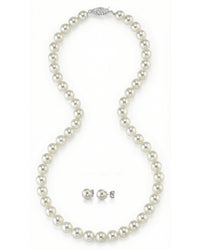
Akoya pearls are graded based on several key pearl grading factors that GIA describes as luster, surface quality, shape, color, nacre thickness, and size. Among these characteristics, luster is considered the most important, as it gives Akoya pearls their famous mirror-like glow. Because Akoya pearls are primarily valued for their brilliance and classic round shapes, they remain one of the most popular choices for pearl necklaces, stud earrings, and other timeless jewelry designs. - Ashley McNamara, PurePearls.com
Akoya pearl necklaces and classic pearl stud earrings are perhaps the most famous, and most coveted cultured pearls in the world, so it makes perfect sense that you’d want to know how they are graded and evaluated, right? While it is true that pearls do not have a set, universal grading system (meaning that pearl grading can vary widely from seller to seller), at Pure Pearls we use the A-AAA Quality Japanese Grading System. This grading scale is used in Japan, and features detailed benchmarks and percentages that pearls have to meet in order to make their grade.
With more than 20 years specializing in cultured pearls of all types, we grade Akoya pearls using the 7 Value Factors. GIA lists these value factors as luster, surface quality, nacre thickness, color, shape, size and origin. All of these attributes are carefully evaluated and balanced against each other to arrive at its grade on the A-AAA Scale and finally its price.
My Akoya Pearl Grading Guide will give you a detailed breakdown on how Akoya pearls are graded and valued here at Pure. Featuring visual aids and a systematic breakdown of what exactly you can expect to observe in each grade, this guide will be like having your very own jewelers’ grading hank.
Feel free to read the whole article, or use the links featured in the Table of Contents to skip ahead directly to parts that concern you.
Use these links to navigate this article:
The job of a pearl grader is to carefully evaluate the Akoya pearl necklace, pair of pearl earrings or single, loose pearls used for pendants or rings based upon the most important attributes Akoya pearls possess: luster, shimmering iridescence, clean blemish-free surfaces and thick nacre. Akoya pearl necklaces of the same size can vary widely in price just based on those attributes alone.
Surface quality and shape are also important, particularly for Akoya pearls, which are traditionally valued for their perfectly round, perfectly matched shapes and smooth, clean surfaces.
For pearl lovers wanting to buy the best Akoya pearl quality they can, knowing how Akoya pearls are graded helps them to know they’re investing in beauty and rarity, not just the largest pearl size they can get.
TLDR: when grading and evaluating Akoya pearls, always prioritize luster first, surface quality second, perfectly round shapes third, color and overtone and finally, size.
👉Learn More: The Insider's Guide Pearl Grading
For buyers new to Akoya pearls (or any cultured pearl type) we know one of their most asked questions we get is: “How can I tell if my Akoya pearls are actually good quality?”
You’re in luck, because with over 20 years of experience sorting, grading and pricing Akoya pearls, I can offer you a few simple tips and tricks you can use to observe and evaluate your new pearls. You don’t need to be a professional grader to quickly and easily recognize beautiful, high quality Akoya pearls when you see them.
Luster is the most important indicator of high quality Akoya pearls. Luster should be highly reflective - almost mirror-like in detail - and reflected light sources should feature sharp, crisp edges with little to no blurring. Pearls with poor luster will appear chalky or dull, like a bead.
Pearls are organic gemstones, born from a biological process, so they will feature some kind of blemish or growth characteristic such as mottling. That said, high quality Akoya pearls should feature surfaces with as few blemishes as possible, and present a smooth, almost glossy surface. Fine quality Akoya pearl layouts should be matched with care to disperse any inclusions so that they are evenly distributed and not easily noticeable when worn.
Akoya pearls are famous for their perfectly round shapes; your pearls should be round, symmetrical and beautifully matched.
Classic Akoya pearls are generally white in appearance with subtle overtones that influence their appearance, and how they look when being worn.
The most desirable overtones include:
Rose overtone offers hint of pink and a warm, soft glow; rose is the most traditional and highly desired in Asia. This overtone should be a nice hint of pink and the pearls should still appear white, not overly saturated so the necklace appears pink.
Silver overtone is bright and crisp with a bright white appearance or a slightly blueish to greenish undertone, cooling the pearls down. Silver is the most popular in Western countries due to its bright white appearance.
Cream overtone is a slightly warmer tone, like a hint of French Vanilla. Cream can be beautifully complex, but the key is to keep it from becoming too heavily saturated so the pearls don’t appear yellow in tone.
Fine quality Akoya pearl necklaces should showcase near-perfect matching for body color, overtone, luster levels, size, shape and surface quality. Some slight differences may be noticeable on mid-range strands when it comes to overtone or luster differences, however the entire layout should still appear harmonious and balanced.
At Pure, we grade our Akoya pearls by concentrating on identifying consistent quality benchmarks and percentages for each grade of the A-AAA Grading Scale. This helps our clients know and appreciate that when they see pearls offered at a specific grade, they know exactly what kind of beauty and value they will be bringing home.
Our grading methods favor luster first, surface quality second, shape, matching, nacre thickness and finally color/overtone, then size. Further down in this article I break down the exact percentages and benchmarks you can expect to see in each A-AAA quality pearl grade. Showing you the method and thinking we use when evaluating our pearls (not to mention our real-life pearl pictures and up-close examinations of our pearls) means that when you're considering a specific grade, you know exactly what level of beauty and value to expect.
Whether our clients are new to pearls or are adding to their already existing collections, our strict grading standards apply to every piece of jewelry on our site. From classic pearl necklaces to sophisticated Akoya pearl stud earrings, a special pearl pendant or a chic bracelet, every loose hank or pair of pearls is closely examined in our Los Angeles workshop for grade-appropriate levels of luster, smooth, clean surfaces, perfectly round and beautifully matched shapes and near-perfect match for size, body color and overtone before we even begin creating your jewelry.
If a pearl or pearls within your loose hank or matched pair appears too blemished, dull or just doesn't match the overtones of the rest of the pearls, we mark them and remove them before finding a better replacement. This guarantees that every item of jewelry leaving our offices demonstrates that the level of care and meticulous craftsmanship is always upheld at Pure, and you can always be confident in receiving a gorgeous pearl necklace or pair of pearl earrings from our experts.
| Pearl Value Factor | Why It Matters | What To Look For |
| Luster | The Brightness and Sharpness of Reflected Objects in the Pearls' Surfaces | Look For Sharp, Highly Detailed Reflections on the Surface; Reflected Light Sources on the Edges Should be Crisp with Little to No Blurring |
| Surface Quality | Blemishes and Growth Characteristics Marring the Surface | Smooth Surfaces with as Few Blemishes as Possible. Blemishes Include Pin Pricks, Score Marks, Pits, Scaly Spots and Flat Spots |
| Shape | Roundness and Symmetry of Shape | Look For Perfectly Round and Almost Perfectly Matched Pearl Shapes in Necklaces, Bracelets and Earrings |
| Overtone and Orient | Pastel Overtones and Iridescent Glow | Rose is Most Traditional - Tinge of Pink. Silver is Most Popular - Bright White with a Hint of Blue Undertone. Cream is a Warm French Vanilla - Works Best on Complexions with Pink/Red Undertones, Red Hair and Grey Hair. Orient is a Rainbow Iridescence on the Best Pearls |
| Matching | Akoya Pearls are Known for their Near-Perfect Matching | Pearls Should Be Near-Perfectly Matched for Color, Overtone, Luster, Shape and Size |
| Nacre Thickness | Durability and Depth of Glow (Luster) | Thick Nacre Layers Create Long-Lasting Pearls and Create the Effect of Luster and Orient |
A smooth, unblemished surface, shimmering iridescent flashes of pink, blue, green and (in the best cases) violet, shimmering over a white primary body color, and of course, their trademark “ball bearing” or mirror-like luster, shining brightly with reflected light and a glow that appears to flow like water over the pearls' surfaces.
These are all the hallmarks of beauty that we expect to see in a high grade Akoya pearl strand.
Akoya pearls are famed around the world for their bright, mirror-like luster. Often the luster is so sharp that it earned the nickname “ball bearing” because the reflections are so sharp, so detailed and the light flows over the surface of the pearl so smoothly, it’s a bit like looking at a metal ball bearing. An Akoya pearl without highly reflective luster loses both beauty and value rapidly.
Separate components of the Akoya pearl’s luster is its iridescent orient and pastel overtones. Akoya pearls are traditionally white in color (there are also dyed black Akoya, naturally colored blue pearls, natural goldens and even natural pistachio greens but that’s for another topic). The white primary body color of these pearls is the perfect base from which to observe pastel secondary overtones of rose, silver and cream.
In addition to those overtones, the finest quality Akoya pearls - usually termed “Hanadama” Akoya - will display an iridescence called orient. Orient is an optical effect that looks like a pink-green-blue-violet flash that shimmers and flares in various lighting conditions. The stronger and more visibly apparent the orient is, the more valuable the pearl will be.
All together, the luster and visible appearance of orient will heavily impact how Akoya pearls are graded and their final prices. Bigger pearls can be impressive and rare, but like with any other pearl type, if the luster is chalky or dull, or the color is flat and lacks iridescence, then smaller Akoya pearls with brighter luster and pronounced orient will be the more valuable.
👉Learn More: Guide to Pearl Overtones
A cultured saltwater Akoya pearl is the product of a synthesis between humans and nature. A mother of pearl shell bead nucleus is inserted into the host oyster, along with a square of donor mantle tissue from another oyster who has previously borne pearls of high or exceptional value, and the oyster is left to begin secreting around the nucleus, eventually forming a pearl.
The crystalline nacre layers are made up of microscopic aragonite platelets composed of calcium carbonate, and bound together with an organic “glue” of sorts called conchiolin. The aragonite platelets are fairly transparent to slightly tinged in color, able to both reflect and refract light rays striking their surfaces, giving pearls their trademark pearl luster and subtle glow. The tighter and more compact this arrangement of crystal is, the brighter the luster the pearl displays and the greater the amount of orient or iridescence.
This internal structure is what gives pearls their beauty, and makes them worthy of their designation as a precious gemstone. However, because these gems are the result of a biological process, they will never be totally, completely, flawlessly perfect. Mother Nature always leaves her mark. It’s our job as dealers, farmers, designers and consumers to separate out the exceptional from the rest. If you’re intrigued, and want to know more, click here to read more about the 7 Pearl Value Factors.
Now that you know a little bit more about the science behind why and how a pearl is beautiful, we can move on to learning about each pearl grade, what it takes for pearls to qualify and how to buy great pearls.
👉Learn More: Deep Dive On Pearl Nacre and How It Impacts Luster
Akoya pearls are one of the smallest of all cultured pearl types, typically ranging from 5.0-5.5mm up through 9.0-9.5mm and very rarely in the 9.5-10.0mm - or even more rarely 10.0-10.5mm. So if all other grading factors are equal - luster, surface quality, matching, etc. - then the larger pearls are going to be the more expensive ones.
Additionally, you will start to notice that after the 7.0-7.5mm size has been reached, prices start to increase exponentially - similar to how diamonds are priced. So an 8.0-8.5mm Akoya pearl necklace will nearly double in price compared to the 7.0-7.5mm version, all other factors being equal.
This is because the larger pearl sizes 7.5-8.0mm and up require much longer time in the water to grow. This increases the risks of storms, red tide blooms and other unexpected calamities, potentially wiping out entire harvests - and the farmer bears the entire cost.
Additionally, the longer growth times require more care and resources invested in the oysters’ health, with daily checks, regular cleaning and investments in state of the art technologies to ensure that the farmer will maintain a nice, healthy crop of pearls to harvest.
At the very largest and rarest sizes of 9.5-10.0mm and 10.0-10.5mm, the size of the oyster itself becomes an issue - as the smallest of all pearl-bearing mollusks, most Akoya pearl oysters are simply unable to accommodate a mother-of-pearl bead nucleus of that size, drastically reducing the availability of oysters able to be used to culture these rare pearl sizes, which will command premium prices for fine quality pearls.
We will always recommend deciding upon your budget first, and then choosing the highest quality Akoya pearl jewelry you can buy within that range - even if it means stepping down in size. A highly lustrous, glowing strand of smooth, unblemished pearls will not only be more beautiful than a large but dull or pitted pearl necklace, but it will also be more beautiful and durable in the long run.
Whether you’re brand new to shopping for Akoya pearls, or have purchased several pieces in the past, we always recommend starting out by establishing a comfortable budget. Akoya pearl jewelry has a wide range of price points, from a few hundred dollars to tens of thousands depending on the quality, size and style of your pearl jewelry. My #1 recommendation is to prioritize Akoya pearls with the highest luster and cleanest surface quality you can within your budget over simply choosing the largest pearl size you can. Because Akoya pearls are prized for their mirror-like luster and radiant glow, pearls with gorgeous luster will always look more beautiful than larger yet dull or chalky pearls.
My #2 recommendation is considering the occasion and meaning of the gift. Akoya pearls are the most popular and most famous cultured pearls in the world … they are also the most classic and versatile pearls you can gift when it comes to pearl jewelry. Their timeless white appearance, subtle yet elegant presence and ability to bring a touch of sophistication to any outfit or occasion makes them the perfect gift for weddings, anniversaries, birthdays, graduations, holiday celebrations and other important milestones in people’s lives. Symbolising wisdom, truth, love, peace and beauty around the world, an Akoya pearl necklace, pendant or pair of pearl earrings can easily become your loved one’s most cherished gift, worn and enjoyed for decades to come.
Lastly, we like to ask about the age, lifestyle and personal style of the person who will be wearing the pearls. Smaller pearl sizes work especially well for young ladies and girls, as the pearls will be delicately pretty rather than overwhelming, while classic pearl necklaces or larger pearl earrings will appeal more to women ranging in age from 20 to 60 years old.
For buyers looking for guidance, these pieces are among the most popular choices:
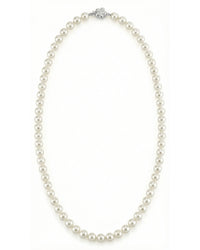
Classic Akoya Pearl Necklaces – The iconic pearl jewelry piece, ideal for anniversaries, weddings, and milestone celebrations. Our most popular size is the 7.0-7.5mm necklace, a moderately-sized and versatile classic white pearl strand that most people think of when they close their eyes and imagine a pearl necklace. Larger pearl necklaces are ideal for important milestones like 30th anniversaries, important promotions, or weddings. Opt for smaller strands under 7.0mm for petite frames, young ladies and girls wearing their first pearls for birthdays, holidays or graduations.
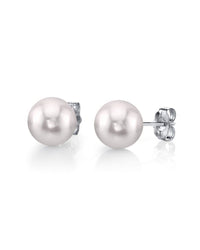
Pearl Stud Earrings – A timeless first pearl gift, perfect for graduations, birthdays, or everyday elegance. Opt for 6.5mm studs for petite women or young girls receiving their “first pearls” gift. Choose the 7.5mm pearl stud earring for women ranging from 20-60 years old - these are our most popular and versatile size. Larger pearl studs 8.5mm and over are ideal for mature women, or women who want their pearls to showcase more gravitas.
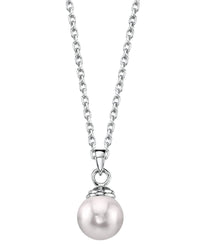
Akoya Pearl Pendants – A simple and sophisticated option that pairs well with almost any outfit. Akoya pearl pendants can be worn anywhere and everywhere, making them ideal as an everyday pearl jewelry choice.
Exact prices vary depending on pearl quality, jewelry design and farmer costs, most Akoya pearl necklaces fall within the following general ranges:
Entry-level Akoya necklaces (AA+ quality) – 'Very High' luster, 90-95% clean surfaces, well-matched pearls. Necklaces can range from $350 to $3,900 depending on pearl size and length.
Mid-range necklaces (AAA quality) – 'Very High to Excellent' luster, 95-99% clean surfaces, and near perfectly-matched pearls. This is one of the most popular quality levels, and prices can range from $900 to $9,000 or more, depending on length and size.
Premium necklaces (Hanadama quality) – Exceptional luster, near-perfect surfaces, and near-perfectly matched pearls. These represent the finest Akoya pearl strands available, and are certified by the Pearl Science Laboratory of Tokyo, Japan. Hanadama Akoya pearl necklaces range from $2,500 up through $9,000 or more, depending on length and pearl size.
This quick price overview will help you compare pearl necklaces more confidently and choose a strand that fits both your budget and quality expectations, whether they are purchasing a first pearl necklace or investing in a timeless heirloom string of Japanese Akoya pearls.
Now that we've covered the building blocks of science of fine luster, nacre thickness, overtones and how size plays a critical role in how Akoya pearls are evaluated, let's dig into the technical aspects of surface quality, and how this all-important value factor looks like on real pearls.
Below are the exact benchmarks and percentages used to grade Akoya pearls on each level of the A-AAA and Hanadama Grading Scales.
The A-AAA Grading Scale is also called the Japanese System, and corresponds to the grading standards used in the sorting houses in Japan before sale and export. Use the images and benchmarks listed below to understand what to expect when you purchase an Akoya pearl necklace or pair of pearl earrings at each grade level.
👉Learn More: The Ultimate Guide to Hanadama Pearls
** Remember that while shopping for Akoya pearls, they are “organic gemstones”, meaning that they are the end result of a biological process.
As such, cultured pearls will never be as flawlessly perfect as a synthetic glass or plastic bead can be – Mother Nature always signs her creations. We do not use the term "flawless" when grading or describing our cultured pearls because of this. Even if the pearl appears "eye clean" to an observer, under a loupe or magnification, there will be growth characteristics and very tiny imperfections that can be identified.
So how does the AA+ vs. AAA Quality comparison play out in real life? Which pearl necklace grade should you choose?
The answer is: that depends on what’s important to you in a pearl necklace. I almost always will advise my clients to opt for the most lustrous pearls they can afford in their budget, but keep in mind that the AA+ Quality pearls are also quite lovely, with between 5-10% more blemishing, so this grade can offer shoppers more wiggle room in price. Let's see how this plays out in real life:
Both the AA+ and AAA Quality Akoya pearl grades are pretty darn close in appearance to the casual observer i.e. someone who’s about a foot or more away from you looking at your pearl necklace shouldn’t be able to tell which is which (all bets are off though if they’ve been trained to look at pearls).
Both qualities are perfectly round in shape, with excellent matching from pearl to pearl throughout their layouts and their surface inclusions are largely white or colorless, making them not easily visible unless you’re conducting an up-close and personal inspection.
The primary difference between the AA+ Quality and the AAA Quality Akoya pearl is one of luster (and this of course is the same issue when comparing the AAA versus our Hanadama Akoya as well). The luster on AAA Quality Akoya pearls will be sharper, brighter and have a greater visual ‘depth’ than that of the AA+ grade pearls.
As a professional in the pearl industry for over a decade, I am a luster and iridescence junkie (full disclosure), and so for my own personal preference, again, I would choose a smaller-sized, high-quality, high luster pearl necklace over a larger, but less lustrous choice.
That said, there are a ton of customers that go for size over luster (and for good reason - who doesn't love to make a pearly splash?), especially since the two qualities are so close to each other in so many other respects.
Ultimately the answer to this question lies within your budget and your own aesthetics.
Each pearl necklace, earring, bracelet and pendant listing on Pure features a drop-down menu on the right side of the page that allows you to customize your pearls to your pearl grade of choice, AA+ or AAA Quality, or even upgrade to certified Hanadama pearls.
As mentioned earlier, Mother Nature always leaves a mark on her creations.
There are a number of common growth characteristics and surface inclusions you can regularly spot on almost any necklace that are typical of the Akoya pearl type.
These markings are a practical and easy way to:
A. Verify that the pearls are genuine cultured pearls and not man-made imitations, which feature perfect, identical beads throughout an entire layout.
B.Identify that particular set of cultured pearls as yours. As you become familiar with the character of your pearls, you’ll notice that each pearl’s inclusions act as a built-in identification system, marking that strand or pair of earrings as yours and yours alone.
The vast majority of Akoya pearl inclusions are white or colorless in appearance, meaning that they aren’t easily noticed by a casual observer.
Additionally, most Akoya pearl blemishes are fairly small and shallow, covering less than 10-15% of the total surface area of the pearl and so are very unlikely to affect the long-term durability of the gem.
The bracelet layout pictured above is composed of A/AA Quality Akoya pearls that were purchased especially for a custom-design project; these are not a pearl quality I regularly stock in the vaults. That said, the number and variety of blemishes featured in just this short 7-inch layout makes it an excellent example to work with in showcasing the most common Akoya pearl blemishes.
Keep in mind that this particular example is for illustrative purposes only – Pure Pearls does not carry Akoya pearl necklaces or bracelets graded under AA+ Quality.
A) Mottling/Bulleting: this is a faint plating pattern on the pearl’s surface, and considered to be the result of very thick nacre accumulation. As such, this is not considered an inclusion per se, however many do find that this feature can mar the smooth surface of the pearls if found in abundance. A colorless feature, this type of growth characteristic does not impact the beauty of the necklace if found upon up-close inspection occasionally, and does not affect the long-term durability of the pearl.
B) Uneven Accumulation of Nacre: in a perfect world, crystalline nacre is deposited in evenly concentric layers over the bead nucleus during pearl formation … in cases like this, the layering process has been interrupted/disturbed in some way, causing a build-up of nacre in a single area.
C) Clustered Pin Pricks: Tiny pin point indentations in the nacre, clustered together in small groups. If clusters are too numerous, the pearls can have a “chewed” appearance.
D) Blinking: This occurs when the nacre covering the shell bead nucleus is very thin. You can observe “blinking” when examining the pearls up close (at a distance of 6-inches or less) by slowly rotating sections of the strand in front of a strong light source. The internal bead will appear to “flash” a yellow-orange color at you.
E) Single Pin Pricks: Tiny pin point indentations in the nacre, isolated from any others. Tiny, and covered in the same color as the rest of the pearl’s nacre, pin pricks are often only distinguished upon up-close, careful inspection and do not impact the pearl’s durability or beauty.
F) Scaly Spot: This is a clear, colorless inclusion called “uroko” in Japan; it usually indicates some kind of event or growth disturbance while the pearl was being formed inside the oyster.
G) Divot/Flat Spot: Exactly what they sound like: nacreous, flat, circular or oval areas on the pearl’s surface … like the pearl was flattened in one area by a tiny hammer. This is a very common pearl growth feature that, like bulleting, is considered indicative of very thick nacre, and as such also do not count towards a pearl’s grading benchmarks.
H) Blinking: See D.
I) Uneven Nacre Accumulation: See B.
J) Diffused Luster: This will show up wherever you see light reflecting off the surface of the pearls … this is not a pearl blemish, but it is one of the 7 major value factors of pearl grading, and as such merits inclusion here while it’s an easily showcased feature. Notice how the edges of the reflected light sources begin to soften and break up, giving the pearl’s luster a softer, less defined look.
I know that the above images can be kind of terrifying, but again keep in mind that these are for illustrative purposes only. PurePearls.com does not stock Akoya pearls below the AA+ Quality grade (see AA+ Quality breakdown above).
Grading Akoya pearls is both science and art … beginning with evaluating the qualities you can touch and measure objectively like luster, surface quality, shape and size, and finishes with articulating the ephemeral ideals of beauty. Smooth, crystalline nacre layers are the building blocks of glowing luster, iridescent overtones and orient. Light kisses the surface of the pearl and penetrates into the pearl’s inner depths, returning to the viewer creating a gorgeous glow, a sense of translucency and shimmering rainbow effects. The finest Akoya pearls can shine like a full winter’s moon.
Our Akoya Pearl Grading Guide was written to help you understand how all these elements can come together to create true beauty. It takes the mysterious process of buying Akoya pearls online and gives you the ability to see exceptional Akoya pearls the moment they are in front of you.
Past millimeter measurements and technical grading charts lies something much more personal … Like snowflakes, no two Akoya pearls are exactly alike. When selected with care, an Akoya pearl necklace becomes more than just another piece of jewelry; it becomes a personal signature showcasing your unique taste and style, to be cherished for a lifetime.
My final advice to you as you shop for your new Akoya pearls:
Luster Is King. Large pearls is a nice idea, but not if they appear dull or chalky. Don't be afraid to step down in size if it gets you the pearls that will shine brightly and light up your face.
Pick The Overtone That Looks Good On You, Not The Popular One. Rose works best for fair complexions, while silver is beautifully paired with complexions that tan easily or are darker. Cream is best worn by women with pink undertones in their complexions, are blonde, have red hair or are older women with grey or silver hair.
Balance Size With Purpose. 7.0-8.5mm Akoya pearl necklaces are moderately-sized and offer versatile elegance for everyday wear; 9.0–10.0mm necklaces showcase larger presence and rarity, more suited to formal events. 5.5-7.0mm pearls are perfect for petite women or young ladies and girls who won't be overwhelmed by larger pearl sizes.
Look For Surface Harmony, Not Perfection. Minor blemishes or natural growth characteristics on the pearl's surfaces are normal, and can even act as an in-built identification system for you. Don't let the perfect be the enemy of the great.
Buy With Intention. Everyday elegance, formal statement strands, or an heirloom investment ... each event or milestone in life calls for slightly different pearl necklace grades, size ranges and pricing tiers.
Saltwater Akoya pearls are graded based on luster, surface quality, shape, color, nacre thickness, and size. Among these value factors, luster is the most important because it determines how bright and reflective the pearl appears.
On the A-AAA Grading Scale, AAA quality Akoya pearls are the highest quality. That said, Hanadama Akoya pearls are chosen out of the AAA quality harvests for their exceptional beauty, luster and nacre thickness and sent especially to the Pearl Science Laboratory of Tokyo, Japan for special certification.
The best Akoya pearl sizes are the ones that are perfect for you. However, the 7.0-7.5mm pearl size is the most popular for women ranging in age from 18 to 60 due to their versatility and moderate sizes. Choose 6.0-7.0mm pearls for women with petite frames or young ladies and girls as their "first pearls" gifts. Larger pearls ranging from 8.5mm through 10.0mm are best suited for mature women, or for formal events.
Japanese Akoya pearls are considered the best of the best around the world. Other locales produce saltwater Akoya pearls, primarily China and Vietnam, however the harvests from China are small in size - both in number and pearl size - and Vietnam produces pearls with exotic colors like blue, pistachio and gold. For classic white Akoya pearls, we recommend sticking with Japanese Akoya as your best choice.
White Akoya pearls with rose overtones are the most valuable and sought after for their pastel rosy glow and effects on many complexions. Rose can pair with both traditional yellow gold clasps and mountings, which will "warm up" the pearls and enhance their sparkle or set with white gold which will cool the pearls down. Silver overtones are the most popular in Western countries, loved for their bright, icy white appearance which pairs beautifully with white gold clasps and mountings.
High-quality Akoya pearls should show:
About the Author
Ashley McNamara, of PurePearls.com, is a GIA-certified expert in Pearls, Diamonds, and Colored Stones and widely recognized as “the expert’s expert” in the pearl industry. With over 20 years of experience, she contributed to the CPAA’s Pearls As One educational course and has been cited by major news outlets nationwide. Ashley's keen eye for color and luster make her a trusted source for classic and exotic pearls alike. Explore her bestselling collections here.

Stay up to date on our latest products, news, discounts, and more!
Free 2-Day FedEx on all orders within the USA. Overnight delivery options start at $35.
Most orders ship within 1-2 business days, sometimes same day.
International shipping is affordable and fast. Most international packages arrive in 2-4 business days.
Your package is fully insured. If your order is lost or stolen before delivery, we got you covered.
Our Pricing Explained
Luxury Grade Pearls. Lower Prices.
Luxury Grade Pearls.
Lower Prices.
The true value of pearls lies in their quality. We sell true luxury grade pearls without traditional luxury store markups.
We source the worlds finest pearls and sell direct to customers like you. You can expect to save about 1/2 the cost of traditional retail.


Pure Pearls Pricing

Traditional Retail Pricing