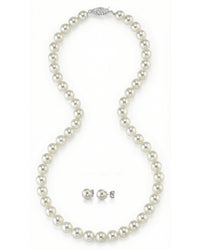
“South Sea pearls are graded by evaluating size, shape, luster, surface quality, nacre thickness, and color together. Large size alone does not determine value. Luster and nacre quality are often more important.”
— Ashley McNamara, Pure Pearls
“South Sea pearls are graded by evaluating size, shape, luster, surface quality, nacre thickness, and color together. Large size alone does not determine value. Luster and nacre quality are often more important.”
— Ashley McNamara, Pure Pearls
South Sea pearls are the largest and rarest cultured pearls on the market, which makes understanding South Sea pearls grading essential for buyers new to this pearl type. Unlike mass-market pearls, small differences in luster, surface quality, and nacre thickness can dramatically affect value and long-term beauty.
With over 20 years in the jewelry industry specializing in cultured pearls, my South Sea Pearls Grading Guide focuses on both White and Golden South Sea pearls, and explains how Pure Pearls’ A–AAAA grading scale is applied in practice when evaluating and valuing pearls. Using real-life photography of pearls in our vaults, side-by-side comparisons, and plenty of visual charts that highlight grading benchmarks and pricing differences, this guide shows what you can realistically expect to see at each quality level. All grading terminology is aligned with standards defined by the Gemological Institute of America (GIA).
You can read the guide from start to finish for a complete foundation, or use the table of contents to jump directly to the grading factors or quality levels most relevant to your buying decision.
Use these links to navigate the article:
| Grading Factor | What To Look For | Why It Matters For Value |
| Size | Typically 9–17mm, with 13mm+ Considered Rare | Larger Pearls Are Exponentially Rarer And Command Higher Prices |
| Shape | Round To Near-Round Is Most Valuable, Smooth Drop Shapes Are Also Desireable | Perfect Symmetry Increases Demand And Matching Difficulty |
| Luster | Bright, Sharp Reflections | Indicates High Nacre Quality And Visual Brilliance |
| Surface | Minimal Blemishes Visible At 6-Inches Or Less Distance | Fewer Blemishes Mean Higher Grading And Price |
| Nacre | Thick, Well-Layered Nacre | Improves Durability And Long-Term Value |
| Color | White, Silver, Champagne, Deep Gold | Rich, Natural Color Increases Desirability |
Finding the perfect strand of White or Golden South Sea pearls for anyone is a balancing act of beauty over budget.
Learning how to choose South Sea pearls is all about finding the right balance between size, quality, and price. These pearls are prized for their rarity and presence, but the most beautiful strand isn’t always the biggest or most expensive. Knowing what truly affects value helps you focus your budget where it matters most, and how to buy South Sea pearls confidently and with ease.
One of the first decisions to make issize. Pearls in the 8–10mm or 9–11mm range are a popular choice for everyday wear because they offer elegance without feeling overpowering. Larger pearls, such as 11–13mm and above, create dramatic impact and are often chosen for special occasions or statement necklaces. Bigger sizes are stunning, but they also come with a noticeable jump in price.
Color is another important consideration. White South Sea pearls are the most popular and versatile option, known for their bright, silvery white hues that pair effortlessly with any wardrobe. They’re timeless, classic, and easy to dress up or down. Golden South Sea pearls, on the other hand, are bold, warm, and naturally rare. While they tend to appeal to a more specific taste, rich golden strands can be incredibly striking and unique.
Budgeting wisely means deciding where to compromise and where not to. For example, an 8–10mm AAA-quality South Sea pearl strand can be found for under $8,000, offering exceptional luster and clean surfaces at a more approachable price point. Move up to 11–13mm large South Sea pearls, and prices typically begin around $12,000 to $15,000, assuming similar quality factors. Setting your budget should always account for luster and overall quality first, with size adjusted to fit your comfort zone.
Shape also plays a big role in value.Round South Sea pearls are the most traditional and command the highest prices due to the difficulty of matching pearls perfectly. Baroque, slightly off-round or button-shape pearls, however, can offer incredible savings. These pearls still have beautiful luster and presence, but their unique shapes allow buyers to enjoy larger sizes or higher quality at a significantly lower cost.
Something to keep in mind during your South Sea pearl evaluation, is that most South Sea pearl inclusions are small and isolated, and their color generally will match that of the surrounding surface nacre. This means they tend to blend in naturally and are usually only noticeable upon close inspection from about 6 to 12-inches away. When worn, these subtle features rarely detract from the necklace’s overall beauty.
This is especially true if the pearl’s overtones and luster are at high levels, masking marks and distracting the eye.
It’s also helpful to understand that the A–AAAA South Sea grading benchmarks evaluate blemishes both on individual pearls and across the entire strand overall. The “90% or 80% blemish-free” guideline refers only to small surface areas, leaving plenty of room for pearls that look clean, smooth, and beautiful to the eye, even in slightly lower grades.
When viewed through the eyes of someone who truly loves pearls, surface features often become part of the charm. Much like a snowflake, no two pearls are ever exactly the same.
In gemology, inclusions in emeralds are famously known as “jardins,” or gardens, and pearls have their own natural markings that tell a similar story. These subtle characteristics are a reminder that South Sea pearls are organic gems, formed slowly by nature. Rather than flaws, they can be seen as signatures of authenticity, giving each pearl necklace its own personality and sense of individuality.
In the end, the best South Sea pearl necklace is one that feels right to you. Whether that means prioritizing size, maximizing luster, choosing White or Golden colors, or discovering value in baroque shapes, understanding these details makes the buying process both easier and far more enjoyable.
South Sea pearls are graded by looking at thewhole pearl or matched strand. South Sea pearl grading standards take all the major pearl value factors and evaluate them together. This includes size, shape, luster, surface quality, nacre thickness, and natural color.
Because South Sea pearls are naturally large and rare, grading is less about chasing perfection and more about understanding how these qualities work together to create beauty.
That said, luster and nacre quality tend to steal the spotlight. Bright, sharp reflections and thick nacre are what give South Sea pearls their glow, durability, and long-lasting beauty. A pearl with excellent luster and clean surfaces can be considered high quality even if it’s slightly smaller or not perfectly round. Reputable jewelers follow grading principles aligned with the Gemological Institute of America (GIA), focusing on clear explanations and realistic expectations rather than flashy marketing grades.
Luster, Luster, LUSTER. And natural pearl colors found nowhere else on Earth. These two attributes are primarily what makes South Sea pearls valuable and coveted by pearl connoisseurs the world over.
White and Golden South Sea pearls are known to have the thickest nacre layers of all cultured saltwater pearl types, averaging between 2.0-4.0mm thick, or more.
Almost universally described by pearlers as “satiny” in look, South Sea pearl luster is softer in appearance than that of the Japanese Akoya Pearls.
South Sea pearls radiate a gorgeous “glow” that appears to emanate from within, rather than the harder “mirror-like shine” that Akoya pearls are famous for.
That’s not to say that South Sea pearls can’t feature very bright, very sharp luster – they can and do. Check out this picture that showcases a pair of Golden South Sea Drops with almost Metallic levels of luster (WOW)..
Luster and nacre quality are two of the most important indicators of a South Sea pearl’s beauty and value. High luster comes from thick, well-formed nacre layers, which allow light to reflect sharply and create bright, mirror-like reflections. Pearls with a soft or hazy glow typically have thinner or less compacted nacre layers and are considered lower quality.
South Sea pearl nacre thickness also plays a key role in how a pearl ages over time. Thicker nacre improves durability and helps a pearl maintain its appearance for decades, making it especially important for fine jewelry and heirloom pieces. In South Sea pearls, strong luster paired with substantial nacre is a hallmark of premium grading.
Like every other cultured pearl variety out there, the visual phenomenon of body color, overtone and luster are due to the compaction and smoothness of the pearl's crystalline nacre layers.
White and Golden South Sea pearls are both nucleated using a perfectly round mother-of-pearl bead nucleus. The nucleus is surgically placed into the gonad of the oyster, along with a tiny, 1.0mm square piece of donor mantle tissue from a different oyster. The incision is covered over and the oyster is placed into an “after surgery” tank for a few days while it heals from the procedure.
After a short time, the bead nucleus stimulates the formation of a pearl sac, which envelopes the nucleus in a loose “purse” and the oyster begins secreting nacre.
This continues on for about 2-3 years, as the oyster continuously covers the interior bead nucleus with thousands of concentric layers of nacre and conchiolin, eventually forming a pearl - hopefully a perfectly round one.
Some definitions you should know are:
The tighter and more compact the aragonite and conchiolin layers are, the more intense the luster, color and orient you will perceive on the pearl’s surface.
Now that you’re a bit more familiar with how and why these various elements combine to create the visual phenomenon of "Wow!" to us humans, we can move onto learning about the A-AAAA South Sea Pearl Grading Scale that Pure uses.
The breakdown below examines each pearl grade, and lays out specific benchmarks that South Sea pearls must meet in order to "make the grade".
South Sea pearls come in a refined but highly prized range of natural colors, with White South Sea pearls being the most popular and widely worn. These pearls are best known for their bright, silvery-white appearance, which is especially valued for its clean, luminous look and versatility. Within this category, subtle overtones matter. White South Sea pearls with rose overtones are the rarest and most expensive, as the soft pink glow adds depth and warmth that enhances overall beauty and grading value.
Golden South Sea pearls offer a completely different, yet equally luxurious appeal. Their color is graded much like gold itself, commonly described in 14K, 18K, 22K, and 24K gold tones, based on depth, richness, and saturation. Lighter champagne shades are also rare, but deep, rich gold tones of 22K and 24K are far rarer and command the highest prices. As with white pearls, grading rewards even color distribution and strong luster, with the deepest, most intense golden hues representing the pinnacle of South Sea pearl color and value.
No South Sea pearls grading guide would be complete without showing you what the pearls look like at each grading benchmark. The images depicted in these grading breakdowns include a mix of perfect round and off-round/button and baroque South Sea pearl necklaces.
Keep in mind that baroque or drop-shaped pearls are graded using the same A-AAAA scale as perfectly round pearls.
In addition to luster, color and surface quality, for baroque and semi-baroque pearls, the symmetry of shapes and shape-matching play very important roles in determining South Sea pearl quality.
The South Sea pearl grading factors used here are luster, surface quality, nacre thickness, shape, color, and matching. Size doesn't really play a roll in grading, as pearls can be any size and still AAAA quality. Instead, size comes into play when pearls are priced, with larger pearls being rarer and thus more valuable.
With Golden South Sea pearl grading, color also plays an important role.
The best rule of thumb to go by is: the deeper the golden color, the rarer and more valuable the pearls are, all other quality factors being equal.
** Cultured White and Golden South Sea pearls are one of the few “organic gemstones” in the world (the others being amber, jet and coral). That means they are the end result of a biological process. Tiny imperfections in even “Gem” quality pearls are expected.
Per the FTC: § 23.26 Misuse of the words "flawless," "perfect," etc. (a) It is unfair or deceptive to use the word "flawless" as a quality description of any gemstone that discloses blemishes, inclusions, or clarity faults of any sort when examined under a corrected magnifier at 10-power, with adequate illumination, by a person skilled in gemstone grading.
Cultured pearls will never be as flawlessly perfect as a synthetic glass or plastic bead can be – nor should you want them to be.
Mother Nature always signs her creations, and these unique inclusions and marks can act as a built-in ID system that marks the pearls as yours and yours alone.
👉Learn More: The Expert's Guide to Pearl Grading
Pure does not offer any AA+ quality round loose or matched South Sea pearl pairs; all round pearl earrings, pearl pendants and pearl rings featured on Pure are AAA Quality minimum.
We use this quality control policy to make sure that each pendant, pair of earrings, or pearl ring that leaves our office will set clean in front and the sides of the pearl, so you’re only showing off pure gorgeousness, and NOT blemishes.
As with all precious gemstones, it pays to remember: price isn’t everything.
Pure’s “AAA Quality Minimum” policy may make our prices appear less competitive at first glance, but this standard exists for a reason. By refusing to work with lower-grade pearls, we ensure that every piece meets a baseline of strong luster, solid nacre, and clean overall appearance. This commitment results in jewelry that simply looks better when worn and continues to look beautiful over time.
This matters especially when it comes to South Sea pearl earrings quality, where close-up viewing and symmetry are critical. Earrings demand well-matched pearls with bright luster and minimal visible blemishes, and lower grades often fall short in these areas.
By starting at AAA quality, we create earrings, pendants and pearl rings that feel refined, balanced, and satisfying from the first wear. In the long run, this approach leads to prettier pearl jewelry, greater confidence in each purchase, and happier, more loyal customers who know they’re investing in quality that lasts.
A full 18-inch strand gives us more flexibility when designing pearl necklace layouts, which allows us to offer a wider range of price points. Our goal is simple: we want every customer to have access to the “Queen of Pearls” without compromising on South Sea pearl necklace quality. Pure offers an array of South Sea pearl necklaces ranging from AA to AAAA quality, making it possible to find a beautiful, well-balanced strand for almost any budget.
From my professional perspective, I almost always recommend choosing a slightly smaller strand with higher overall quality rather than going bigger at the expense of luster. The same goes for shape. It’s easy to get fixated on “perfectly round,” but roundness alone doesn’t define beauty or value. What truly elevates South Sea pearl necklace quality is luster, and orient when visible.
Remember that luster - and orient whenever visible - makes or breaks these little guys as gemstones, so aim to up that “L” factor whenever possible.
That said, there’s no denying the WOW Factor that a really large layout of White or Golden South Sea pearls exudes. The off-round / button-shape South Sea pearl necklace pictured just above crossed my desk in 2016 and was gone within a few weeks (because look at that Orient, it's to die for pretty)
Ultimately, what are the best quality South Sea pearls is up to you. Snagging a screaming deal like this depends on whether off-round and button-shaped pearls, or a few inclusions is a huge turn off for you, or if the luster and orient that is plain to see here overwhelms those other factors.
👉Learn More: 7 Value Factors of Pearls
Size is a big factor in what affects South Sea pearl price, because these pearls take their time growing. South Sea oysters need years to produce a single pearl, and only a small percentage ever reach truly large sizes. That’s why pearls over 11mm are already considered rare, and genuinely large pearls are even harder to come by.
When it comes to price,each millimeter matters more than you might expect. Value doesn’t increase in neat, even steps. A jump from 12mm to 13mm reflects a real leap in rarity, farming risk, and time invested, which is why prices can rise sharply as size increases.
In fine quality, 13–15mm South Sea pearls are often viewed as investment-grade. These sizes offer dramatic presence and true scarcity, especially when paired with bright luster and thick nacre. For buyers thinking long term, they represent some of the most desirable and enduring pearls available.
👉Learn More: The Ultimate Guide to Pearl Sizes
With Pure’s South Sea necklace collection, you’ll come across necklaces with grades that will look like "AA/AAA Quality" and/or "AAA/AAAA Quality" in their descriptions. These “intermediate” grades are given to pearl strands when the pearls almost-but-not-quite make it to a whole letter grade like AAA Quality.
Generally, what these intermediary grades mean is that the pearl’s surface quality (i.e. amount of inclusions) or shape is graded at a lower level like AA, but the pearl’s luster and shine pushes the layout to that higher grade.
It could also be the reverse in that the pearls’ surfaces are extremely clean, but the luster isn’t quite there. However, I usually grade strands like that with a lower grade anyways because what makes pearls beautiful as a gemstone?
That's right: Luster.
Let’s see how this plays out with real South Sea necklaces …
Check out the photo above showing a section of GRD-0817-PURE, an 18K Medium-Deep Golden South Sea Round Pearl Necklace which was given an intermediate AAA/AAAA Grade. Notice in particular:
So based on ourpearl grading value factors we have:
Surface blemishes, imperfections and natural growth characteristics that interrupt the smoothness of the pearl’s surfaces are what we call "inclusions" in the jewelry industry.
Nearly all South Sea pearls have natural surface features, and that’s completely normal. These pearls grow slowly inside living oysters, so a perfectly flawless surface is the exception, not the rule. Small marks or gentle variations are simply part of their natural character.
When pearl experts evaluate surface quality, they focus onwhat you can see at a normal viewing distance, not tiny details under a loupe. If a blemish isn’t noticeable when the pearls are worn, it usually has little impact on beauty or value. What matters most is the overall look and feel of the necklace.
Cleaner surfaces become especially important when pearls are matched for earrings or necklaces. The fewer visible blemishes there are, the easier it is to pair pearls that look balanced and harmonious together, which is why cleaner pearls elevate the quality and value of fine strands and classic stud earrings.
In this section, I’ll break down what is and is not an inclusion (it’s not always what you think): how these growth characteristics effect the pearl, and how they can affect value.
South Sea pearl blemishes and growth characteristics are an easy way to:
Most White and Golden South Sea pearl blemishes are the color of the corresponding nacre (so, gold or white in color), so often these surface blemishes don’t stand out glaringly unless they’re very deep or there are a lot of them bunched together.
The pictures below are all of White and Golden South Sea pearl strands that are raw, unretouched photos (so no “glamourizing” has been done here).
Keep in mind that these are close-ups of inclusions on pearls for educational purposes … in other words, don’t get scared by the focusing on the spots.
Mottling/Bulleting/Plating of the Surface – “Mottling” also known as “Bulleting” and sometimes “Plating” is a subtle texture on the surface of the pearl that (to me, at least) often looks like a tiny hammer has been used to repetitively mark the pearl.
This is a growth characteristic, and NOT an inclusion – it’s actually indicative of very thick nacre layering. Mottling is created in the same nacre color as the rest of the outer surface of the pearl, and so usually can only be noticed upon up-close inspection. Bulleting does not count against a pearl’s surface grade.
Pin Pricks – Ranging in size from a tiny needle points to small pricks that look like the pearl has been poked with a pencil, pin pricks are probably the most common pearl inclusion visible today.
Pin pricks can be grouped together in small clusters, or stand on their own individually, which is preferable.
Pits – These formations are pin pricks taken to extremes, and resemble large indentations, craters or even holes in the nacre.
Pits count as heavy or deep blemishes when grading a strand of pearls, and their best case scenario is that they are at least the color of the pearl, and totally covered by nacre.
Worst case scenario is they are very deep and display the organic conchiolin layer; jagged, sharp edges may eventually lead to chipping.
Score Marks / Grooves - Scoring and/or groove inclusions are the second most common South Sea pearl inclusion.
They resemble tiny streaks to moderately-sized channels that look “carved” in the surface nacre (often they remind me of little shooting stars or comets trailing their way across the pearl when they’re very thin and light).
The shallower, the better when it comes to scoring marks, and these should also be totally covered in nacre, with smooth, unbroken edges.
Knobs and Tips – Maybe one of the most interesting looking growth characteristic of all.
Both tips and knobs form on the ends of the pearl (99% of the time on baroque shaped pearls). Occasionally, knobs can have additional features that resemble small bubbles. They can be rounded or elongated, pointy protrusions located at either end of a pearl.
Knobs and tips are natural growth characteristics and are also not counted as inclusions or blemishes.
Keep an eye out for chipping or cracking however, as these vulnerable areas may affect the pearls’ long-term durability.
Circles / Circling – Originally marketed for black Tahitian pearls under the “Circles of Love” campaign in the 1980’s, “circles” or “circlés” are also a natural growth characteristic that does not count negatively towards the surface grade of the pearl.
These are single or heavily concentrated rings running around the pearl’s entire circumference, and imbue the pearls with an incredibly unique appeal.
Again, circles are not pearl blemishes, but, blemishes can form inside them (usually in the form of tiny pin pricks or grooves).
Uneven Nacre Accumulation –Smooth, concentric and even layers of nacre producing a totally unblemished, shiny pearl surface is ideal.
However, nacre building within an oyster responds to a variety of factors: environmental, temperature fluctuations, parasites, etc., can all interrupt this process to some degree or another.
When the layering process is disturbed, a build-up of crystalline material can occur, resulting in bumps, ridges and uneven surfaces.
These stunning White South Sea pearl necklaces showcase everything you could want in fine, AAAA Quality South Sea pearls: bright, crisp luster, iridescent orient and fine, bright colors.
South Sea pearls sit at the top of the pearl world for good reason. Production is limited from the very start, as South Sea oysters are large, sensitive, and can only produce one pearl at a time. Cultivation takes several years, and farmers must invest significant time and care before a single pearl is ready for harvest.
Even with that investment, mortality rates during farming are high. Not every oyster survives the process, and not every surviving oyster produces a pearl suitable for fine jewelry. This natural risk is one of the biggest reasons South Sea pearls are rarer and more expensive than other cultured pearls.
At harvest, selection becomes even stricter. Only a small percentage of pearls meet fine-quality standards, especially in larger sizes. Pearls with weak luster, thin nacre, or excessive blemishing are filtered out early, leaving only the best for necklaces and matched sets. This combination of limited supply, time-intensive growth, and rigorous selection is what drives South Sea pearl pricing upward.
👉Learn More: How Much Do Pearls Cost?
These drop-shaped White South Sea pearl strands feature some light inclusions which brings their prices down, but the high quality of the luster and orient makes them an excellent buy for the right client.
Higher grades are beautiful, but they aren’t always the smartest choice for every buyer or every piece of jewelry. Slightly off-round or baroque South Sea pearls can offer exceptional value, especially in necklaces where perfect symmetry is less noticeable. These shapes often allow buyers to enjoy larger sizes or stronger luster at a lower price.
Minor surface blemishes can also be a non-issue in the right setting when it comes to pendants, earrings or rings. Small marks are often hidden by drill holes, prongs, or bezels, making them virtually invisible once the pearl is set. When worn, these pearls can look just as elegant as higher-grade options.
Most importantly, strong luster can outweigh small cosmetic flaws. A pearl with bright, sharp reflections and thick nacre will look vibrant and luxurious, even if it has a few natural surface features. For many buyers, prioritizing luster over technical perfection is the key to getting the most beauty and long-term enjoyment for their budget.
8–10mm or 9–11mm: Ideal for everyday wear, lighter feel, better value
11–13mm: Statement size for special occasions, higher price tier
Remember: each millimeter increase adds significant cost
Look for bright, sharp reflections, not a soft or hazy glow
Strong luster signals thick nacre and long-term durability
A slightly smaller pearl with great luster often outshines a larger dull one
White South Sea pearls: Most versatile, classic, and easy to wear anywhere
Golden South Sea pearls: Rich, warm, and naturally rare, best for bold style
Choose even, luminous color rather than depth alone
Round pearls: Most traditional and most expensive
Slightly off-round or baroque: Excellent value with the same luster and size impact
Perfect symmetry matters less in necklaces than in stud earrings
Minor blemishes are normal and often invisible when worn
Grading focuses on what’s visible at normal viewing distance
Cleaner surfaces matter more for pendants than matched strands
Under $5,000: 8–10mm AAA-quality baroque strands with strong luster
$8,000–$10,000+: 8–11mm strands AAA to AAAA quality, round shapes
Adjust size first, not luster or nacre, to stay within budget
Daily wear: moderate size, high luster, comfortable weight
Occasions: larger pearls, bolder presence
Long-term value: thick nacre and overall balance over technical perfection
Grades are guidelines, not guarantees
A well-balanced strand can outperform a higher-graded but uneven one
Choose the necklace that looks and feels right to you
South Sea pearls can be a good investment when they are viewed as rare, long-term stores of value rather than short-term speculative assets. They are produced in limited quantities, grown slowly over several years, and harvested from some of the world’s most sensitive oyster species. Unlike mass-market pearls, supply cannot be quickly increased to meet demand, which has historically supported steady price appreciation for fine-quality South Sea pearls.
In recent years, that demand has accelerated. According to industry reporting from the American Gem Trade Association, prices for white South Sea pearls rose by more than 20% between 2022 and 2024, driven by constrained supply and global demand (Pearl Update: Prices Are Still Climbing, AGTA). At the same time, surging demand from China has played a major role in pushing South Sea pearl prices higher, particularly for larger sizes and fine-quality strands, as reported by JCK Online (Surging Chinese Demand Is Fueling Dramatic Increases in Pearl Prices). These trends align with what we’ve seen firsthand. In2024, I wrote about how increased demand from China and limited farm output combined to fuel double-digit price increases for South Sea pearls across multiple size categories, which you can read about in my Pearl Industry 2024 Market Update.
That said, South Sea pearls are better considered heirloom investments rather than financial instruments.The strongest long-term value is found in pearls with exceptional luster, thick nacre, large size, and careful matching ... qualities that hold their appeal across generations. While resale should not be the primary motivation, buyers who prioritize rarity and quality are often rewarded with pearls that retain desirability, increase in value over time, and become meaningful pieces passed down for decades to come.
While South Sea pearls may show long-term price strength, but their true value goes far beyond market trends or percentages. When selected with care, South Sea pearls reward pearl lovers not just with lasting quality, but with the confidence that they’ve chosen something rare, meaningful, and made to endure.
With that understanding in place, our focus shifts from numbers to actual purpose. Knowing how to evaluate South Sea pearl grades, interpret South Sea pearl grading charts, and recognize real-world inclusion examples allows all of our buyers to move forward with clarity and intention. From here, it’s less about “investment” and more about making the right choice: one that reflects your personal style, celebrates special moments, and creates an heirloom that will be worn, loved, and passed down for generations to come. A purchase that adds to Your Story, forever.
As a pearl specialist for over two decades in this industry, I know that understanding South Sea pearl grading charts and real-world inclusion examples takes the mystery out of buying fine pearls. When you know what to look for and how to evaluate size, luster, nacre, surface, and shape together, you’re no longer guessing. You’re comparing with confidence, recognizing true quality, and choosing pearls that offer genuine beauty and value. The knowledge my South Sea Pearl Grading Guide empowers you to with is the ability to look beyond labels and make decisions that feel right, both visually and financially.
Known as the "Queen of Cultured Pearls", South Sea pearls are more than just jewelry. They are markers of moments, symbols of milestones, and pieces that quietly collect stories over time. A well-chosen strand becomes something worn at celebrations, passed from one generation to the next, and cherished not just for its beauty, but for the memories it carries. It becomes part of your story. By learning how to properly evaluate South Sea pearl grades, you’re not just buying pearls. You’re choosing an heirloom meant to be loved, remembered, and treasured for generations to come.
👉Learn More: The Ultimate South Sea Pearl Buyer's Guide
Luster is the most important grading factor for South Sea pearls. It reflects the quality and thickness of the nacre and determines how bright, sharp, and alive the pearl appears. A smaller pearl with excellent luster is often more valuable than a larger pearl with dull shine.
Luster shows nacre quality and overall health of the pearl
High luster creates brightness, depth, and visual appeal
Size alone does not outweigh poor luster
No, larger South Sea pearls are not always better. While size increases rarity and value, a large pearl with weak luster, thin nacre, or visible blemishes can be worth less than a slightly smaller pearl with excellent overall quality. Grading always weighs size alongside luster, nacre, and surface quality.
Size adds value, but only when quality is high
Luster and nacre often matter more than millimeters
Smaller, high-quality pearls can outperform larger, dull ones
The best grade of South Sea pearl to buy depends on how you plan to wear it and what matters most to you. For most buyers, high-quality grades such as AAA or AAAA offer the best balance of beauty, durability, and value, with strong luster and clean surfaces at a more approachable price than top-tier pearls. Lower grades can still be excellent choices when luster is strong and minor blemishes are not noticeable when worn.
AAA–AAAA grades provide the best balance of quality and value for most buyers
Prioritize luster and nacre over size or perfection
Choose the grade that fits how often you’ll wear the pearls and your budget
South Sea pearls do not have a single, universal grading certificate like diamonds. Some laboratories and sellers provide appraisal reports or quality descriptions, but there is no globally standardized certificate that assigns an official grade. Reputable jewelers instead grade pearls using criteria aligned with Gemological Institute of America (GIA) standards and disclose quality factors transparently.
There is no universal or mandatory grading certificate for pearls
Reports may describe quality but do not assign official grades
Trustworthy sellers follow GIA-aligned grading principles and full disclosure
High-quality South Sea pearls show bright, sharp luster, thick nacre, and clean surfaces when viewed at a normal distance. The pearl should reflect light clearly, feel substantial for its size, and display an even natural color without dull or chalky areas. Quality is determined by how these factors work together, not by size alone.
Look for strong luster with crisp reflections
Thick nacre gives weight, durability, and long-term beauty
Minimal visible blemishes and even natural color indicate higher quality
Yes, South Sea pearls are easily worth the price for buyers who value rarity, size, and long-term quality. Their high cost reflects slow growth, large oyster size, limited production, and thick nacre that supports lasting beauty. Well-chosen South Sea pearls can offer better longevity and heirloom value than lower-priced pearl types.
High prices reflect rarity, farming time, and low harvest yields
Thick nacre supports durability and long-term appearance
Best value comes from balancing luster, nacre, and size rather than size alone
South Sea pearls can hold strong long-term value when quality and rarity are prioritized, but they should be viewed as heirloom purchases rather than financial investments. Large sizes, exceptional luster, thick nacre, and clean surfaces help preserve value over time, especially in well-matched strands. Their true return is durability, beauty, and generational significance rather than short-term resale profit.
Best value comes from high luster, thick nacre, and larger sizes
Rarity supports long-term desirability, not speculative gains
South Sea pearls are best viewed as heirlooms meant to be worn and passed down
About the Author
Ashley McNamara, of PurePearls.com, is a GIA-certified expert in Pearls, Diamonds, and Colored Stones and widely recognized as “the expert’s expert” in the pearl industry. With over 20 years of experience, she contributed to the CPAA’s Pearls As One educational course and has been cited by major news outlets nationwide. Ashley's keen eye for color and luster make her a trusted source for classic and exotic pearls alike. Explore her bestselling collections here.
Free 2-Day FedEx on all orders within the USA. Overnight delivery options start at $35.
Most orders ship within 1-2 business days, sometimes same day.
International shipping is affordable and fast. Most international packages arrive in 2-4 business days.
Your package is fully insured. If your order is lost or stolen before delivery, we got you covered.
Our Pricing Explained
Luxury Grade Pearls. Lower Prices.
Luxury Grade Pearls.
Lower Prices.
The true value of pearls lies in their quality. We sell true luxury grade pearls without traditional luxury store markups.
We source the worlds finest pearls and sell direct to customers like you. You can expect to save about 1/2 the cost of traditional retail.
Pure Pearls Pricing
Traditional Retail Pricing